WordPress or a custom website: what should a small business choose?
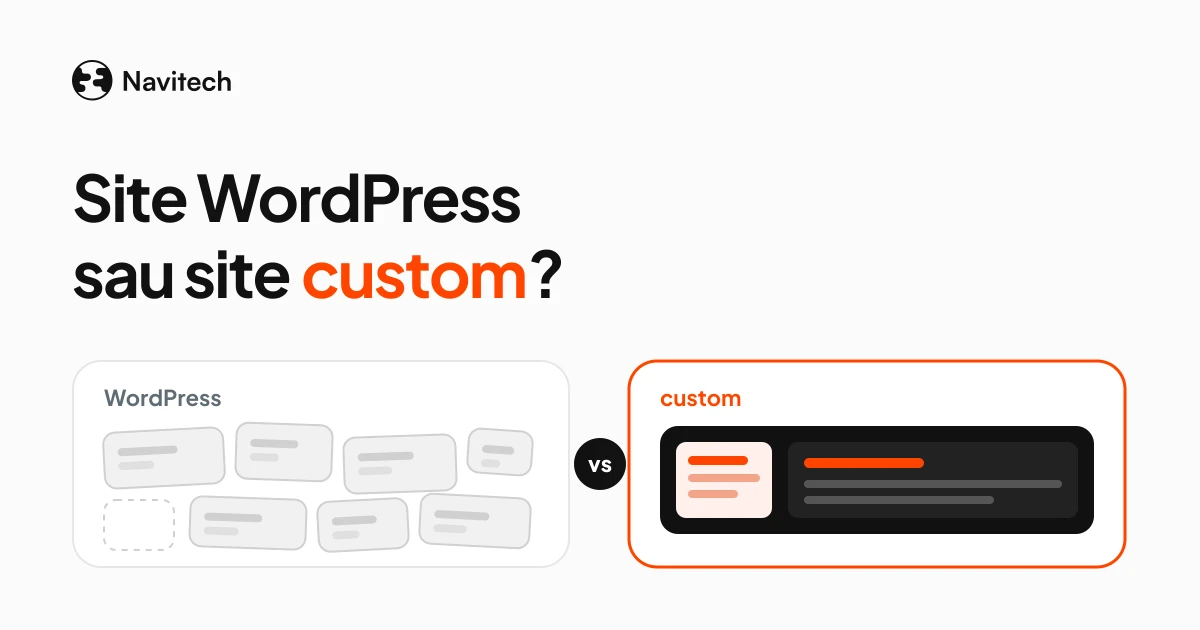
WordPress vs custom website? Pick WordPress if your site is a brochure site with a blog and someone on your team updates it often. Pick custom if the site is really an application: client accounts, price calculators, integrations with your CRM or invoicing system. The launch price matters less than you think. What decides it is what you pay over three years and who looks after the site once it's live.
WordPress runs 39.6% of all websites and 58.3% of those whose CMS is known (W3Techs, 20 October 2026). It's the default choice, not a wrong one. But a default is worth checking before you pay for it.
Which question decides between WordPress and custom?
Just one: who updates the site after launch, and how often?
The answer differs from one business to the next:
- A law firm that publishes one article a month. The office manager or a partner writes the text, adds a photo and clicks "Publish". That's exactly what WordPress was built for.
- A construction company that last changed its services page two years ago. Here the editor barely matters. What matters is speed, how the site looks on a phone, and that no one breaks into it while it sits unattended.
- A distributor that wants partners to see their orders and invoices. That's no longer a website, it's an application with a login. WordPress can stretch that far with plugins, but every plugin is one more dependency to maintain.
If the answer is "nobody, almost never", the main argument for WordPress, the friendly editor, falls away. What's left is the cost of keeping it up to date.
What does WordPress cost compared to custom, over 3 years?
The build is only the first line on the bill. Below are the costs that can be checked publicly. Where there's no sourced figure, the table says "varies".
| 3-year cost | WordPress site | Custom site | Source |
|---|---|---|---|
| Build | varies widely by market and agency | from €1,000 excl. VAT at Navitech | Navitech |
| Domain and hosting | varies (needed for both) | varies (needed for both) | — |
| Caching plugin (WP Rocket, 1 site) | €149.85 + taxes (€49.95/year) | not needed | WP Rocket |
| SEO plugin (Yoast Premium, 1 site) | $356.40 excl. VAT ($118.80/year) | not needed | Yoast |
| Updates and maintenance | varies | varies | — |
| Repairs after an attack | varies | varies | — |
Just two paid plugins add €149.85 + taxes and $356.40 excl. VAT over three years, on top of the build. Many sites run more: a page builder, a forms plugin, a backup plugin, a security plugin. On a custom site, speed and technical SEO are written into the code, so there are no yearly licenses for them.
That doesn't make custom automatically cheaper. A new page with a new type of content is built by a developer, not by you. On WordPress you can often do it yourself in ten minutes. That's why the question above matters more than the table.
How secure is a WordPress site?
The WordPress core rarely has problems. Plugins often do.
In 2025, 11,334 new vulnerabilities were found in the WordPress ecosystem, 42% more than in 2024. 91% were in plugins, 9% in themes and only 6 in core (Patchstack, State of WordPress Security in 2026).
Two figures from the same report matter for a small business:
- 46% of vulnerabilities had no fix from the developer when they went public. You can install every update and still be exposed.
- For the most heavily exploited vulnerabilities, the median time to mass exploitation was 5 hours. If nobody is watching the site, nobody is installing the update within five hours.
Every plugin you install is one more door. A WordPress site with 5 well-chosen plugins on automatic updates is reasonably safe. One with 30 plugins, built by a freelancer three years ago and untouched since, will get hacked sooner or later.
A custom site isn't invulnerable either, but it's a smaller target. It doesn't run the same code as millions of other sites, so an automated attack written for a popular plugin finds nothing to hit. Its security depends on who wrote it and how often it gets updates.
Is a WordPress site slower than a custom one?
On average, yes. It doesn't have to be.
In 2025, only 45% of WordPress sites passed Core Web Vitals on mobile. Duda reached 85% and Wix 74% (Web Almanac 2025, CMS chapter). The report's authors note that more extensible platforms, WordPress and Drupal, improved less, by around 4% a year.
It comes down to how WordPress sites are usually built: a theme that does everything, a page builder on top, and a handful of plugins that each load their scripts on every page. A carefully built WordPress site can be fast; it just rarely gets built that way on a small budget.
Speed matters not only for Google, but also for the AI assistants that read your page when they recommend a business.
When is WordPress the right choice?
For many small businesses, WordPress is a good choice. Specifically when:
- the site has fewer than 15–20 pages and a blog;
- someone on the team publishes or edits content at least monthly;
- the special features come down to a contact form and maybe a map;
- there's a yearly budget, even a small one, for updates and backups;
- you have less than €1,000 for the build and want the site in a few weeks.
On that last point: if you have €600 and want a themed site you can edit yourself, we're not the right fit. Our Website package starts at €1,000 excl. VAT. Get a WordPress site on a good theme from a freelancer with verifiable reviews, and ask them to hand over admin access and a list of the installed plugins.
When is a custom website worth it?
When the site starts doing things, not just showing them. Examples we see often:
- A price calculator or configurator. The client picks options and sees a price. On WordPress, that usually means a paid plugin plus custom code on top to make it do exactly what you want.
- Client accounts. Orders, documents, the history of your work together. Here the site becomes a web application, and the costs look more like those of an app project.
- Integrations. The form sends the lead to your CRM, an order creates an invoice in your accounting system, a booking lands in the team calendar.
- High traffic or paid campaigns. A slow landing page loses visitors you've already paid for.
All of this can be done on WordPress too. The catch is what it costs to maintain. Once the site depends on 20 plugins that all have to keep working together after every update, custom can end up the cheaper option in the long run.
What do we build at Navitech?
Navitech's Website package starts at €1,000 excl. VAT and includes design in Figma and custom development, not a bought theme. Hosting, domain and post-launch maintenance aren't included: you pay for them separately.
We don't build on WordPress. We build client sites custom, on our own framework and CMS. After launch, you edit your own content from an admin panel, without calling us for every comma.
If the project includes client accounts, integrations or a mobile app, it's a web/mobile application project, starting at €5,000 excl. VAT. You can see what we've delivered so far on our work page.
Frequently asked questions
Is WordPress free?
The software, yes. The website, no: you pay for the domain, hosting, usually some premium plugins and the time of whoever installs the updates. WP Rocket and Yoast Premium alone cost €49.95 + taxes and $118.80 excl. VAT a year (WP Rocket, Yoast).
Can I move from WordPress to a custom site later?
Yes. Text, images and articles can be exported. What's easy to lose are the URLs: if page addresses change without redirects, you lose your Google rankings. Ask for the migration to include a redirect list for every old page.
How many plugins are too many?
There's no official number. Our rule: every plugin needs a reason, a developer who keeps it updated, and someone on your team who knows why it's there. With 91% of WordPress vulnerabilities in 2025 coming from plugins (Patchstack), every plugin you remove is one less risk.
Is a custom website better for SEO?
Not automatically. What counts is speed, page structure, titles and content. On speed, a custom site can have an edge: in 2025, only 45% of WordPress sites passed Core Web Vitals on mobile (Web Almanac 2025).
Can I edit the content of a custom website myself?
It depends on how it's built. Some custom sites have an admin panel for text, articles and images. Others need a developer for every comma. Ask before you sign, and ask for a demo of the panel.
Not sure which one fits you?
Tell us what your business does, who will look after the site and what you want it to do beyond presenting you. We'll tell you whether you need a custom site or whether a well-built WordPress site is enough, and send you a clear quote.
Sources
- W3Techs, Usage statistics and market share of WordPress (20 October 2026): https://w3techs.com/technologies/details/cm-wordpress
- Patchstack, State of WordPress Security in 2026 (2025 data): https://patchstack.com/whitepaper/state-of-wordpress-security-in-2026/
- HTTP Archive, Web Almanac 2025, CMS chapter: https://almanac.httparchive.org/en/2025/cms
- WP Rocket, Pricing: https://wp-rocket.me/pricing/
- Yoast, Yoast SEO Premium: https://yoast.com/wordpress/plugins/seo/
- Navitech, packages and prices: https://navitech.systems/en


We build digital solutions that deliver results, not just promises.
Tell us what you want to build, and we’ll help you turn your idea into a digital product that delivers real results.

NAVITECH SYSTEMS S.R.L. as beneficiary, announces the start of implementation of the project: "BumbleAds", with SMIS CODE 343446, funded from the Regional Program Nord-Est 2021-2027, Priority 1 "A more competitive, more innovative region", Call: Support for developing the innovation capacity of SMEs through demonstrative projects of SMEs proof-of-concept.
The project is implemented in the period 23.12.2025 - 22.12.2027, in Suceava Municipality, University Street No. 15A, Attic, Suceava County, Romania.
The Management Authority is the Agency for Regional Development Nord-Est.
The project's goal consists of developing, testing and validating an intelligent platform called BumbleAds, designed for integrated management of digital marketing campaigns and customer relationships (CRM). The project aims to implement an innovative conceptual model that brings together in a single application functionalities for analysis, reporting, automatic optimization through AI and complete administration of customer relationships.
Specific objectives of the project
Objective 1: Development of a "BumbleAds" web platform concept for integrated management of digital marketing campaigns and customer relationships (CRM), validated at TRL level 4.
Objective 2: An evolved and tested BumbleAds web platform concept at TRL level 5
The project has a total value of 1,238,938.34 lei, of which the non-reimbursable financing is 976,387.84 lei, of which ERDF 829,929.66 lei and state budget 146,458.18 lei.
Expected results:
The BumbleAds platform, with the following characteristics:
- Native integration of AI (artificial intelligence) for generating reports in natural language, budget recommendations and problem anticipation;
- Unification of data from multiple advertising platforms (Facebook, Google, TikTok, etc.) into a single accessible dashboard;
- Directly integrated CRM functionalities (contracts, invoices, client portal, communication automation);
- Intuitive interface, adapted for users with different levels of expertise (specialists, managers, end clients).
Project Manager: Daniel-Ionuț GRIGORAȘ, tel.: +40 728.309.319, e-mail: daniel@navitech.systems.
For detailed information about the Regional Program Nord-Est 2021-2027, we invite you to visit https://www.regionordest.ro/ and https://www.adrnordest.ro/ , and regarding other programs co-financed by the European Union, you can access https://mfe.gov.ro
