Flutter, React Native or native in 2026: what it means for your app budget
Contents
- What do native and cross-platform mean?
- How do they compare for your budget?
- When is cross-platform the right choice?
- When is a native app worth it?
- What is a "hybrid" app, and why does it matter?
- What happens when Apple or Google change their requirements?
- How easily can you switch suppliers later?
- Do you have to launch on iOS and Android at the same time?
- What does Navitech do?
- Frequently asked questions
- Have an app idea?
- Sources
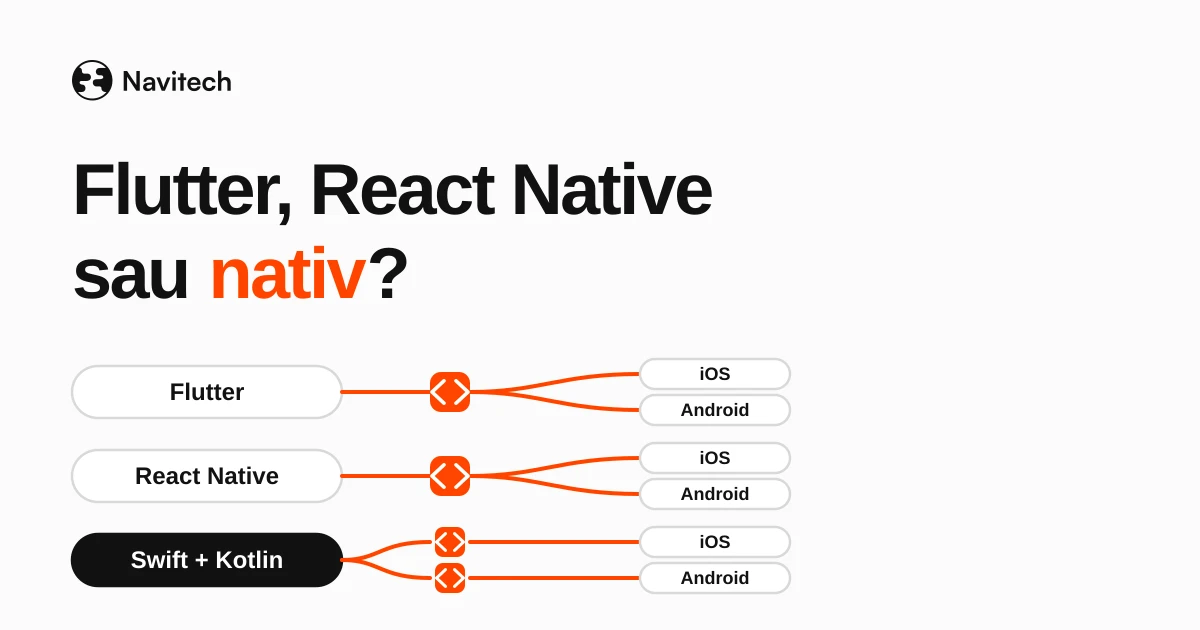
Flutter vs React Native or native? For most business apps, such as ordering, bookings or customer accounts, go cross-platform: Flutter or React Native, with one codebase for iOS and Android. Native, meaning Swift for iOS and Kotlin for Android, is worth it when the app depends heavily on the hardware or the operating system. The difference between Flutter and React Native matters less for your budget than the difference between one codebase and two.
This article is written for the person paying for the app, not for the developer. We don't compare syntax or benchmarks. We compare what you pay and what you risk over the next few years.
What do native and cross-platform mean?
Native means two apps: one written for iOS, usually in Swift, and one for Android, usually in Kotlin. Each uses its platform's tools directly.
Cross-platform means one codebase that produces both apps. The main options are:
- Flutter, from Google, which draws the interface with its own engine. Version 3.47 was released on August 12, 2026 (Flutter, What's new).
- React Native, from Meta, which uses each platform's native components. Since version 0.76, the New Architecture is enabled by default (React Native blog), and the current version is 0.88 (React Native, versions).
There's also a third path: Kotlin Multiplatform, where you share the logic across platforms and can share the interface too, through Compose Multiplatform. JetBrains declared Compose Multiplatform stable on iOS with version 1.8.0, and the Kotlin Multiplatform documentation lists iOS as a stable platform (JetBrains, Kotlin Multiplatform documentation). It's a good option mainly for teams that already have an Android app in Kotlin.
How do they compare for your budget?
| Criterion | Flutter | React Native | Native (Swift + Kotlin) |
|---|---|---|---|
| Codebases to maintain | one | one | two |
| Team you need | people who know Dart and Flutter | people who know JavaScript or TypeScript and React | an iOS team and an Android team, or people who know both |
| Best fit | business apps, identical interface on both platforms | business apps, especially if you already have a React web team | heavy hardware requirements or deep system integrations |
| Main risk | you depend on one framework for everything the app draws | you depend on third-party libraries for native features, which have to be updated along with the framework | two codebases to keep in sync, so two sets of bugs |
We've deliberately left hours and prices out. The point here is a multiplier: with native, almost everything you build gets built twice.
When is cross-platform the right choice?
In our view, for most business apps. If your app comes down to forms, lists, orders, payments, notifications and a customer account, one codebase is enough and cheaper to maintain.
An example from our portfolio: Akropoli Delivery, the app we built for a Greek restaurant, where customers browse the menu, customize their order and pay from their phone. We built it cross-platform, like AutoHub. It's the kind of app that works just as well on iOS and Android and doesn't need special hardware access.
We choose per project: business apps we build cross-platform, and we go native, in Swift and Kotlin, when the requirements call for it.
Between Flutter and React Native, the choice mostly comes down to the team. If you already have web developers working in React, React Native is closer to what they know. If you're starting from scratch, both are good choices for a business app.
When is a native app worth it?
When the app works intensively with the phone itself:
- augmented reality or real-time video processing;
- complex Bluetooth, for example with medical or industrial devices;
- widgets and deep system integrations: the lock screen, the watch, the voice assistant;
- apps where every millisecond of animation is part of the product.
In these cases you can still use cross-platform, but you end up writing a lot of native code on the side. At some point you're paying for the framework and for two native codebases.
What is a "hybrid" app, and why does it matter?
Some quotes call an app "hybrid" when it's really a website shown in a WebView, a browser hidden inside an app. That's not the same as Flutter or React Native. It looks and feels different, and it usually has a harder time reaching the phone's features.
Apple's App Store rules say explicitly that an app should include features, content and UI that elevate it beyond a repackaged website (App Review Guidelines, 4.2). If you get a quote that's much cheaper than the others, ask directly: is it Flutter, React Native, native or a WebView? Get the answer in writing before you sign. If what you need is really a website with a few extra features, start with our comparison of WordPress vs custom websites.
What happens when Apple or Google change their requirements?
It happens every year, whatever the technology. Since April 28, 2026, apps uploaded to App Store Connect must be built with Xcode 26 or later, using the iOS 26 SDK (Apple, Upcoming Requirements). From August 31, 2026, new apps and app updates on Google Play must target Android 16 (API level 36) (Google Play Console Help).
For your budget, this means an app is never "finished". Someone has to update it at least once a year so you can keep publishing updates. Cross-platform adds one more dependency: the framework has to support the new requirements, and you have to update it. With native, you do the update twice.
How easily can you switch suppliers later?
It's worth asking before you sign. Because Flutter, React Native, Swift and Kotlin are public, widely used technologies, another supplier can take over the code, on one condition: that you get it. Write down in the contract who owns the code and the app store accounts. We explain how in our project brief template.
The real risk comes with proprietary solutions that only the original supplier can change. Ask up front whether the app uses anything that isn't publicly available.
Do you have to launch on iOS and Android at the same time?
Not necessarily, even with cross-platform. Having one codebase doesn't make testing and publishing free: each store has its own review and rules. We wrote about this in our article on MVPs: validate the core flow first, then expand.
What does Navitech do?
Navitech's web/mobile app package starts at €5,000 excl. VAT, with an MVP delivered in 2 months. We write the project brief together with you, and it's included in the quote. You can see the projects we've delivered, including the mobile apps Akropoli Delivery and AutoHub, on our work page.
Frequently asked questions
Flutter or React Native: which is better?
For a business app, neither is clearly better. What matters is the team you have and the team you can find later. If you already have React developers, React Native is the easier fit.
Is a cross-platform app slower than a native one?
In our view, for forms, lists and payments, users usually don't notice the difference. It shows up with complex animations, video, AR or intensive hardware work, where native has the edge.
Can I switch from cross-platform to native later?
Yes, but it means rewriting the app, not updating it. If you know from the start that you'll need AR or complex Bluetooth, start native.
What does Kotlin Multiplatform mean for me?
It's a third path, useful mainly if you already have an Android app in Kotlin and want to add iOS without writing everything from scratch.
Should I specify the technology in my project brief?
Only if you have a reason: an existing team, existing code or an integration that requires it. Otherwise, describe what the app has to do and ask each supplier to justify their choice.
Have an app idea?
Tell us what it has to do, who it's for and which platforms you want it on. We'll reply with a clear quote.
Sources
- Flutter, What's new in the docs (Release 3.47, August 12, 2026): https://docs.flutter.dev/release/whats-new
- React Native, React Native 0.76 – New Architecture by default: https://reactnative.dev/blog/2024/10/23/release-0.76-new-architecture
- React Native, Versions: https://reactnative.dev/versions
- JetBrains, Compose Multiplatform 1.8.0 Released: Compose Multiplatform for iOS Is Stable: https://blog.jetbrains.com/kotlin/2025/05/compose-multiplatform-1-8-0-released-compose-multiplatform-for-ios-is-stable-and-production-ready/
- JetBrains, Kotlin Multiplatform: supported platforms: https://www.jetbrains.com/help/kotlin-multiplatform-dev/supported-platforms.html
- Apple, Upcoming Requirements: https://developer.apple.com/news/upcoming-requirements/
- Apple, App Review Guidelines, 4.2: https://developer.apple.com/app-store/review/guidelines/
- Google Play Console Help, Target API level requirements: https://support.google.com/googleplay/android-developer/answer/11926878
- Navitech, packages, prices and projects: https://navitech.systems/en, https://navitech.systems/en/work
Daniel-Ionuț Grigoraș